Are you actually answering the question?

A GCSE English Literature guide
Imagine you’ve written an essay full of your best ideas. Then you get your essay back from your teacher. Instead of it being full of ticks, it’s empty.
That’s something I’ve seen happen in GCSE English Literature exam scripts.
Genuinely brilliant essay material — left unannotated by the examiner.
The reason this happens is students aren’t answering the question, giving examiners little to reward.
Here’s my advice for making sure you answer the question, so you get the marks you deserve.
Get the basics right first: figure out the key words
Start by searching for the words relating to theme or character.
This is the stuff that, if switched, would completely change the task.
Look at the example question below:
Explore how Shakespeare presents Macbeth and betrayal in Macbeth (1606-7)
Some of the words in this question, like ‘explore’ and ‘presents’, are pretty much in every English Literature question.
But the words relating to specific characters (Macbeth) and themes (betrayal) are specific to this question.Swapping Macbeth out for Lady Macbeth, for example, would lead to a very different essay.
So here are your key words. Highlight them, circle them, write them down in capital letters, on every page: whatever makes them stick.
Everything else depends on this first step.
Use the key words 5+ times per paragraph
Now you’ve picked out the most important words in the question, you need to use them. More than you think.
My target for students? At least 5 times per paragraph, 15 to 20 times per essay, especially near a paragraph’s start and end. Sometimes I even have students tally up the total.
If I read a student's paragraph and their writing has strayed from the question, I’ll go through it with a highlighter and highlight every mention of the question’s main words.
Long stretches without colour shows you exactly where your paragraph went off track.
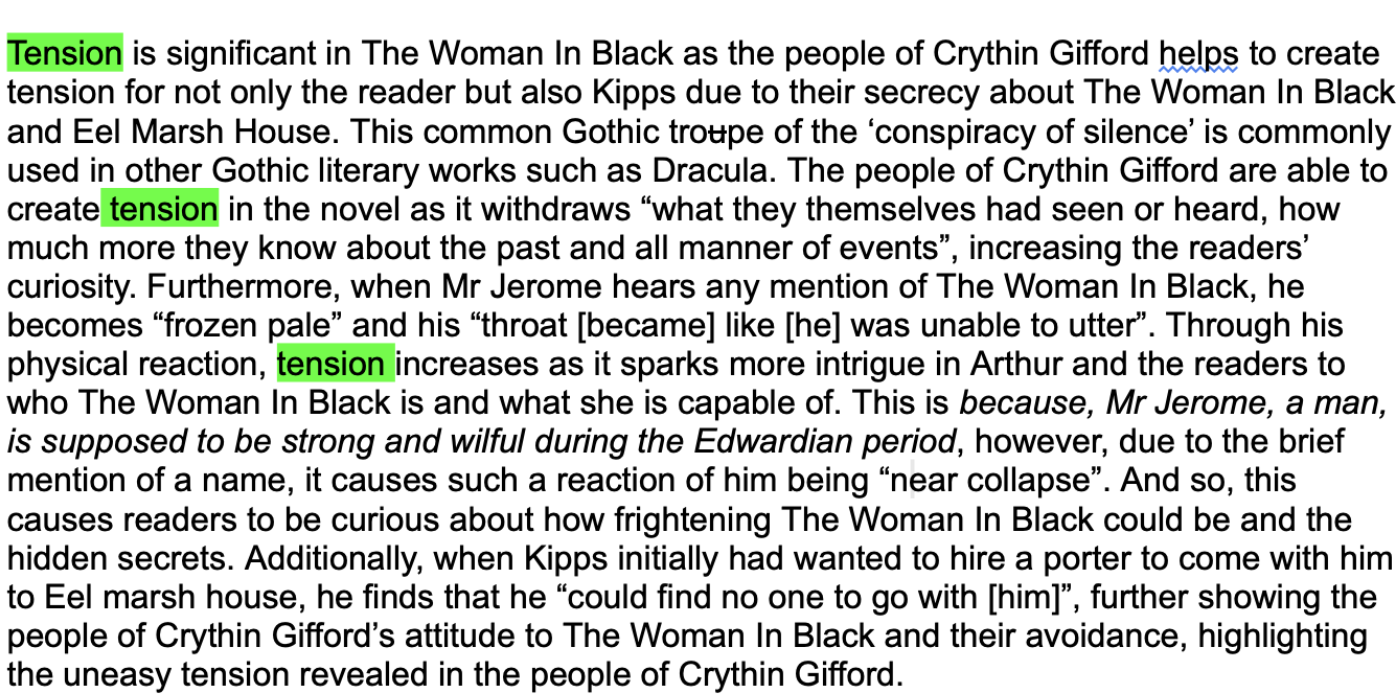
Example of a student’s paragraph going off topic by the end. What did we notice? The key word of the question (tension) didn’t appear in the second half.
Don’t use synonyms
I understand why you might think that, after a while, examiners would get bored of reading the exact key words of the question, over and over again.
You might be tempted to switch ‘betrayal’ with ‘trickery’ or ‘deception’ for variety.
Showing off a varied vocabulary is usually a good thing in English exams.
But when it comes to the key words of the question, that doesn’t apply.
Don’t give an examiner any opportunity to think your essay’s not answering the task.
If you skim it, the words of the question should pop out all the way through.
Use explanatory words (‘because’/ ‘as’/ ‘since’)
Just using the words of the question helps a lot, but sometimes you will need to prove your ideas actually are related to the question.
So it is absolutely crucial to avoid dropping in a bunch of memorised notes, writing ‘this shows (theme of question)’ then calling it a day. I’ve seen this really hurt students’ performance.
Explain why by following it up with ‘because’, ‘as’, or ‘since’ to make sure you’ve convincingly linked your ideas to the task.
Use ‘Not just…, but also…’/ ‘however’/ ‘yet’ to explore the question’s layers
My students' teachers often encourage them to look at the ‘layers’ in a text.
I completely agree. Essays which explore a theme from just one perspective can sound quite flat, like they’ve got stuck on one idea and don’t move past it.
For that reason, I encourage my students to use phrases like ‘not just…, but also…’ to encourage them to think about the question from multiple angles.
For example:
Shakespeare does not just explore Macbeth’s betrayal of his king, but also Macbeth’s betrayal of his own morals.
Now the essay goes off in a fresh and exciting direction, but one which is still very relevant to the question.
I also encourage students to avoid words like ‘additionally’ and ‘furthermore’ to join up their paragraphs, and instead opt for ‘however’ or ‘yet’ for the same reasons.
Writing with twists and turns like this often forms the best essays — a piece of advice I got from my professor in our first university seminar which I’ve never forgotten.
You can even put ‘however’ or ‘yet’ midway through each paragraph, so that each paragraph makes 2 (related) points, rather than one, giving your essay double the insights into the question’s theme.
So there they are!
My top tips for ensuring you answer the question you’ve been set.
Use this advice to make sure your GCSE English Literature essays are always relevant. This way, even the harshest examiners can’t say your writing has gone off track.
Get in touch if you’d like me to mark your essays and get personalised feedback on how to improve.